About the Course
Scared about your upcoming Organic Chemistry course?
With the preparation from my Summer Orgo Prep self-paced short course, you don’t have to be!
I’m sure you’ve heard the horror stories:
- “Orgo is impossible!”
- “It’s designed to weed-out students!”
- “None of Organic Chemistry makes any sense!”
- “There’s just SOOOO much to memorize!”
You might even be feeling anxiety and uncertainty about the course, even before classes begin. But the question is – are you ready to change that narrative?
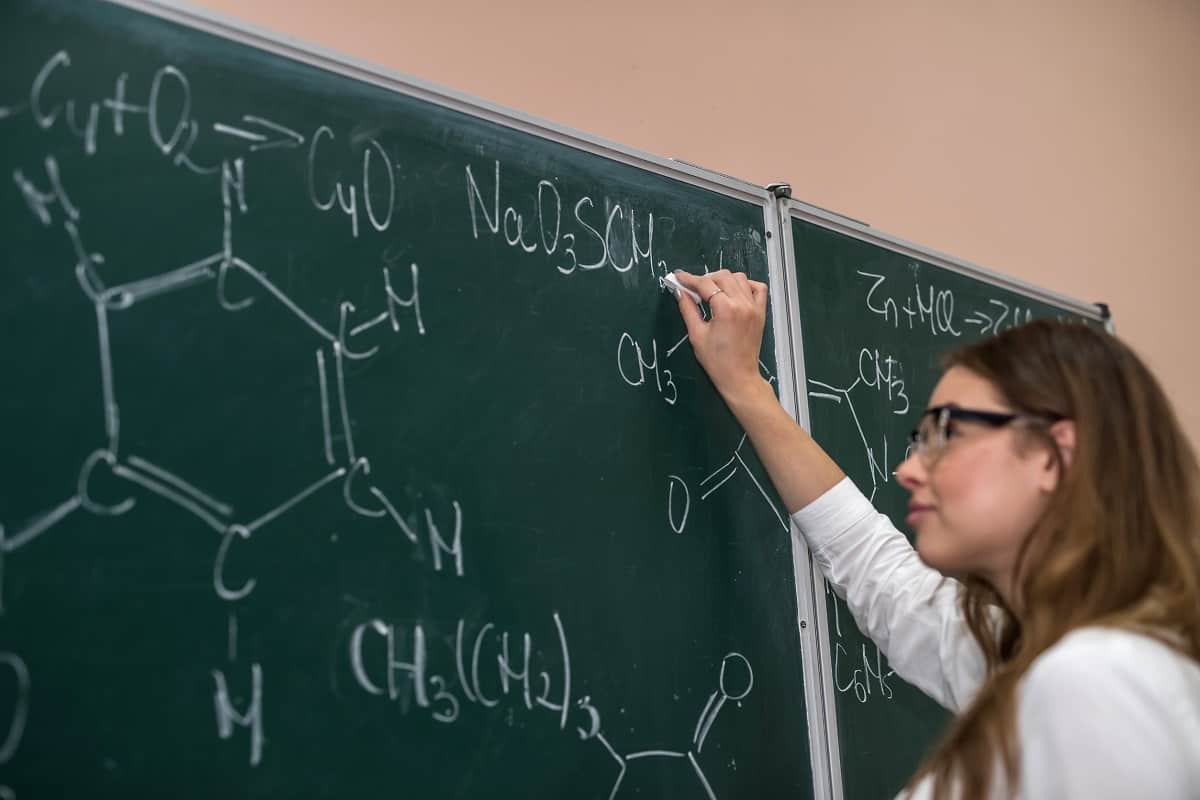
Imagine sitting down for your first Organic Chemistry lecture – confident, calm, prepared!
Visualize this: Throughout your entire Orgo course, you know the terminology; you’ve mastered the basic principles. You’re not just surviving the course; you’re thriving. Every new concept is a challenge you’re ready for, every problem a puzzle you’re eager to solve. You’re no longer a student fearing the weed-out, but a capable learner engaging with the subject with understanding and depth. What if we told you this could be your reality?
That’s where Summer Orgo Prep comes in:
Summer Orgo Prep is an innovative, self-paced short course designed to shift your mindset, and to equip you with the tools for success.
Build the proper foundation WELL before YOUR actual course begins.
Take advantage of the summer break and get a head start while you still have time and flexibility. With a strong foundation, you’ll be ready to conquer Orgo when classes begin!
Unravel the complexities of Organic Chemistry, learning at your own pace and on your own schedule. This short course is designed to give you the tools that will help you navigate the maze of Organic Chemistry, demystifying its intricacies and equipping you with the confidence to excel.
Let’s redefine the Organic Chemistry experience. No longer a subject to dread, but a challenge to embrace. No longer a course that’s overwhelming or “impossible,” but one that’s manageable and makes sense.
Orgo doesn’t need to be a barrier anymore; instead, it can be your stepping stone to even greater achievements.
Turn fear into confidence, turn dread into excitement, and turn the infamous weed-out course into an opportunity to shine. Organic Chemistry, together.
Course Features
- Easy to Navigate
- Automatically Track Your Progress
- Check Your Learning with Quizzes
- Certificate of Completion
- Both video and written lessons
- 1-Time Payment for 1-year Access
- Taught by a nationally recognized expert
Course Content
You’ve probably heard that Orgo is really hard. But the truth is, it is very conquerable, and even fun and rewarding! Why, then, are countless students defeated by Orgo every year? So much of it has to do with Organic Chemistry being different from other courses you’ve taken before, demanding a different approach. In this module, I’ll explain how Organic Chemistry is different, and I’ll talk you through that approach that Orgo demands.
Much of this module is a steppingstone from General Chemistry to Organic Chemistry. It gives you a chance to brush up on some General Chemistry topics on molecular structure and stability, which are a vital part of the foundation we need before diving into upcoming Organic Chemistry topics. This module isn’t just a review of General Chemistry, however, because we’re going to extend things from what you may have learned in General Chemistry, applying these concepts toward new Organic Chemistry problems.
Drawing resonance structures—and their accompanying curved arrows—is arguably the single most important skill to help students master Organic reactions later on. That’s why I’ve devoted an entire module to this topic. Here I will explain the meaning behind resonance structures and curved arrow notation, and I’ll teach you a systematic way to use curved arrows to draw resonance structures quickly, comfortably, and effectively.
Here we deal with the three-dimensional nature of organic molecules, and the impacts this three-dimensionality can have on the way that molecules interact with one another. Like the topics in Module 2, the topics in this module might be familiar to you from General Chemistry. But also like Module 2, this module is not simply a review; we’ll extend these topics toward solving new problems in Organic Chemistry. Furthermore, a major feature of this module is teaching you how to use molecular modeling kits, in order to dramatically simplify the inherent challenges that come with trying to see molecules in three-dimensions from different angles.
In this module, I introduce the general idea of isomers, and the fact that there are actually four major types of isomers you need know and be able to work with. We’ll then dive into two of those types of isomers in this module: constitutional isomers, and conformers. We’ll not only learn how to recognize them, but we’ll also learn how to draw them. As we do, we’re going to continue to use molecular modeling kits, in order to simplify these tasks and to make our lives easier.
Module 6 continues our work with isomers, which began in Module 5. Here we take a dive into the remaining two majors classes of isomers: enantiomers and diastereomers. Working with enantiomers and diastereomers leads into the concept of chirality, which describes whether a molecule is actually different from its own mirror image. The topics in this module ramp up the demand for analyzing three-dimensional molecules from different angles, and I’ll show you ways to use molecular modeling kits to dramatically reduce that complexity.
Mastering the concepts of reaction mechanisms is arguably the biggest factor for success in Orgo. This is the first of two modules dealing just with reaction mechanisms. Here I introduce the general idea of mechanisms, as well as the general idea of elementary steps that make up reaction mechanisms. Then we’ll examine, in detail, the most common elementary steps that you’ll see throughout an entire year of Orgo. These common elementary steps will be your tools to help you master reaction mechanisms.
The concept of charge stability is very important for our understanding of elementary steps—the major topic introduced in Module 7. Here we’ll learn what charge stability means, and what kinds of conclusions we can make about charge stability just from a molecular structure. Ultimately, the lessons we learn about charge stability will help us understand, and even make predictions about organic reactions.
This is the second of two modules devoted primarily to reaction mechanisms. Whereas Module 7 introduced elementary steps, in this module I teach you how those elementary steps can be combined in various ways to make multistep mechanisms. Most organic reactions are described by multistep mechanisms, so we need to know how elementary steps can be put together in reasonable ways.
In Module 10, we learn that some reactions can compete with one another. That is, the same reactants can undergo reactions in different ways to make different products. We’ll specifically look at how and why the four reactions called SN1, SN2, E1, and E2 undergo such a competition. And we’ll learn valuable lessons as to how to make reasonable predictions about the outcome of that type of competition. In other words, we’ll learn how to predict the winning reaction.
In this final module, we’ll review some of the big ideas we learned along the way. We’ll especially review some of the strategies I introduced you to in Module 1, because those strategies will be more meaningful to you now that you’ve seen concrete ways they can be applied. And we’ll end with ways that you can apply those strategies to other topics we didn’t cover in this prep course—topics you’ll encounter in your actual Orgo course.