About the Instructor

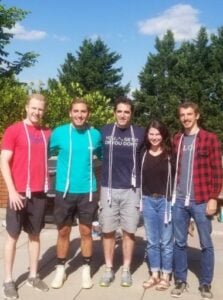
My name is Dr. Joel Karty, or as my students like to call me, “Dr. J.”
A special for our beta testers!
You'll pay only
I’m a professor of Organic Chemistry at Elon University in North Carolina (ranked by U.S. News & World Report as the #1 national university for undergraduate teaching). I’ve been there since 2001, and during these last 24 years, I’ve learned so much about teaching “Orgo,” and how students learn best.
I’ve learned from my colleagues at Elon, I’ve learned from colleagues at professional conferences, and most importantly, I’ve learned from my own students! And the things that I’ve learned, you can learn through this self-paced Summer Orgo Prep short course. I want you to be ready to truly succeed when you take Orgo back at your home institution!
How We Got Here
What’s the “origin story” of Summer Orgo Prep? It really begins when I was back in high school, on my first day of Chemistry class. My teacher, Mr. Jack Howard, was in his 33rd of teaching high school, and he told us that he was going to retire at the end of the year. A little later on in his introduction, he said something that I’ll never forget: “I’m not a smart man, but I know how to convert units.”
So converting units is mostly what we worked on all semester, not much else. And by the end of the semester, I was really good at converting units! (But not much else.) The reason that message from Mr. Howard was so memorable—and so powerful—is because of what I found out it meant later on, when I took General Chemistry my first year in college at the University of Puget Sound. A lot of the material in that course was new to me—not surprising, because we didn’t cover much material in my high school Chemistry class. But what I also discovered was that most of the new material we were learning in General Chemistry depended critically on knowing how to convert units. In other words, converting units was foundational.
And because Mr. Howard made us so good at converting units, I realized I came into General Chemistry with an incredibly strong foundation, so the new material that relied on converting units just kept making sense. Certainly, with the new material always making sense, it became much more straightforward and easier to learn. I went on to earn one of the top grades in the entire course, all because Mr. Howard kept hammering home unit conversions back in high school.
Falling in Love with Chemistry
That great experience in General Chemistry catapulted me into more great experiences in other Chemistry classes. I went on to get my B.S. in Chemistry at the University of Puget Sound, and then my Ph.D. in Chemistry at Stanford University. I loved Chemistry so much, and I especially loved my learning experience at the University of Puget Sound, because of its focus on undergraduate teaching. That’s why I sought out a teaching career at a place like Elon University, and why I devoted my life to teaching Orgo. I wanted to “pay it forward,” so future generations of students can have great experiences and great success like I did. Through it all, I’ve built my teaching around that powerful message that Mr. Howard instilled in me:
Know your foundations—REALLY know your foundations—and the next material becomes much more understandable and easier to learn.

Now, as you’ll find out (if you don’t know already), Orgo has almost nothing to do with unit conversions. But Mr. Howard’s message about mastering the foundations applies more than ever!
That’s what my Summer Orgo Prep self-paced short course is all about. I’ll take you through the concepts and ideas that are the most foundational for learning all of Organic Chemistry, and I’ll show you how to use them to solve problems. In fact, my Summer Orgo Prep short course is modeled after the in-person prep course that I designed, and then taught for 15 years, as part of the Summer Biomedical Sciences Institute (SBSI) at the Duke University School of Medicine. That prep course at the SBSI would admit 1st– and 2nd-year students from colleges and universities throughout the country, who had aspirations of medical school, but who were at-risk of not getting there. Most of my students in that course had just completed a full-year of General Chemistry but didn’t do so well. Some students already had credit for Organic Chemistry, but they needed to retake it because of a bad experience and a poor grade their first time through. Regardless of what they had under their belts coming in, the vast majority of my students in that in-person prep course at the SBSI ended up having terrific success when they took Organic Chemistry the next fall back at their home institution, in most cases earning an A or B.
If you take the time in the weeks or months leading up to your actual Orgo course, to work through my Summer Orgo Prep self-paced short course, to really master these foundational concepts and ideas, you’ll be ready for success when your actual Orgo course begins. It starts now!
– Dr. J.