01.2 Reaction Mechanisms: The Biggest Difference Between Struggle and Success in Organic Chemistry
Reaction mechanisms are SUPER important!
 In Lesson 1 of this Module, we talked about the reasons why it’s better to commit to understanding and applying basic concepts in Organic Chemistry, instead of trying to memorize everything. Here in this Lesson, we’re going to take that idea a bit further, to talk about one specific concept: reaction mechanisms. Module 7 is where I’ll introduce reaction mechanisms in detail, and we’ll work with reaction mechanisms extensively in Modules 7 – 10, but I believe that it’s really important for you to know about the general idea of reaction mechanisms now, because of how important reaction mechanisms are. Hands-down, for most students, the biggest difference between struggle and success in Organic Chemistry is how much they have mastered reaction mechanisms. OK, well if that’s the case, then why are we waiting until Module 7 before talking about them in detail? The answer is simple: To fully understand and work well with reaction mechanisms, we first need to have a good grasp of other key concepts. Those are the concepts that Modules 2 – 6 are devoted to. And if you know how vital reaction mechanisms are, and that the concepts in Modules 2 – 6 are really important for learning mechanisms, you’ll be that much more motivated to make yourself an expert on the stuff we cover in Modules 2 – 6.
So what are these things we call reaction mechanisms?
I said we’re not going to get into the details here, so instead, I want you to think of a reaction mechanism like a set of driving directions that your phone app might give you when you’re driving from point A to point B, where you’re told where and when to turn at each step of the way. But instead of a set of driving directions, a reaction mechanism is a set of steps that takes a reaction from a beginning reactant molecule to an ending product molecule; it shows how a beginning reactant molecule transforms into an ending product molecule. And instead of steps that tell you where and when to turn while driving, the steps in a reaction mechanism describe small, instantaneous changes to the structure of a molecule. In other words, if you start with the structure of a reactant molecule, and follow the steps that make up the reaction mechanism, you’ll end up with the product molecule for that reaction.

Why, then, are reaction mechanisms so important? The biggest reason is that they simplify learning reactions, in two major ways. First, as you’ll see in Module 7:
- There are only 10 common types of steps that make up the mechanisms for the hundreds of reactions you’ll need to know for your year of Organic Chemistry.
Even better, those common types of steps are all pretty straightforward to understand. Therefore, it is much easier to learn those 10 steps, and how they combine to make up reaction mechanisms, than it is to memorize the specific details for each of those several hundred reactions.
The second big reason mechanisms simplify your learning of reactions is that:
- Mechanisms have patterns that are easy to recognize.
Think about it. If there are hundreds reactions that are presented to you, and their mechanisms are made from various combinations of just 10 different kinds of steps, then certain groupings of steps are bound to appear over and over. Those groupings of steps are the patterns I’m talking about, and when you see such patterns appear in mechanisms for different reactions, then those different reactions will end up feeling like the same reaction to you. But on the other hand, without knowing the mechanisms, you won’t be able to see those patterns, and you’d have to treat each reaction as independent and unrelated. That is, without reaction mechanisms, it’ll feel like there’s a ton more stuff you need to know, and that’s when things become overwhelming.
A made-up example of reaction mechanisms
Rather than just telling you how important reaction mechanisms are for learning reactions, I want to use an example to make sure you’re convinced. But since we’re not going to go into detail about mechanisms here, I’m going to use a made-up analogy instead. For our analogy:
- Instead of molecules, we’ll use shapes that I simply made up, which sort of look like bugs that have legs and wings. Here are a couple examples:
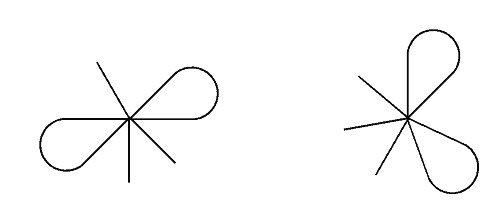
We’ll distinguish these “bugs” from one another by their legs and wings—not only the number of each, but also how they are arranged. So, for example, the two “bugs” above both have three legs and two wings, but the bugs are different because they have different arrangements of the legs and wings.
- Instead of a chemical reaction being something that converts a reactant molecule into a product molecule, our “reactions” will convert one type of “bug” into another. (Think of it as really fast evolution!)
Working with this analogy, then, let me give you the following 10 “reactions.”
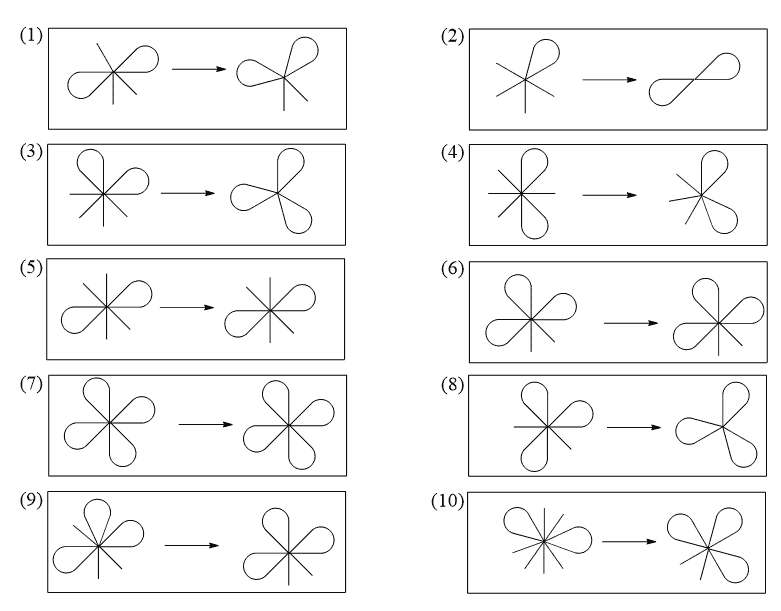
And just like real reactions that you’d be given in your Organic Chemistry course, pretend that you’ll be responsible for knowing these hypothetical “reactions” on an upcoming exam. So take a few minutes right now to “study” each of the above “reactions.” And realize at this point that your only option for studying is to try to memorize these “reactions,” because you don’t know anything about WHY the are the way they are.
Cue the theme song to Jeopardy…
…DUN, dah-dun, dun, dun…dun…dun.
Now, pretend it’s time for the test. And WITHOUT LOOKING AT THE ANSWERS ABOVE, see how you do on the following “exam” question:
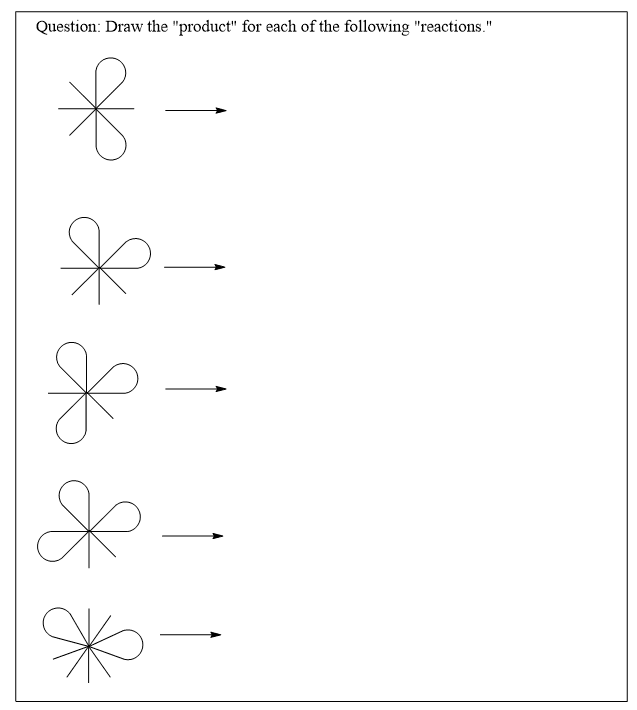
How did you do? If you didn’t get them all correct, don’t worry. In fact, don’t worry if you didn’t get any of them correct; I’d be impressed if you got even two or three! And that’s the point, because the only thing you were able to do to prepare for the “exam” is memorize, without any context for why each particular transformation occurs the way it does. Therefore, each transformation ends up being its own independent, disconnected piece of information.
Now let’s try it again, but this time from the perspective of “mechanisms.” Earlier I described a mechanism as a set of steps that explains how a reactant molecule transforms into a product molecule, with each step being a small, instantaneous change in structure. For our transformations of one “bug” into another, let me give you two different kinds of steps, which we’ll call Step A and Step B.
- Step A: When one leg is sandwiched between two adjacent wings, like is shown here, delete the leg.

- For that example, when you delete the leg, it’ll look like this:

- Step B: When there are four legs all together, like is shown here, connect the middle two legs together to make a new wing.
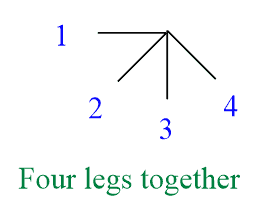
- For that example, when you make the new wing, it’ll look like this:

With these two types of steps available, we create a “mechanism” by first determining which step we can carry out on the initial “bug.” We carry out that step to arrive at a new “bug,” and then we determine what kinds of steps we can carry out on the new “bug.” We simply repeat this process until we can no longer carry out either of the two steps. For example, for the beginning “bug” below, we would construct a three-step “mechanism,” and at the end of the third step, there are no more options to carry out any further steps.
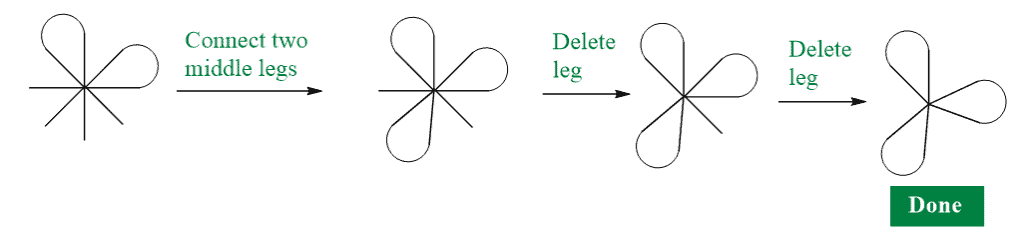
As another example of constructing one of these “mechanisms,” take a look at the following video I made.
Now that you know how these “bug” transformations take place, take another few minutes to practice drawing the “mechanisms” for all 10 of the “reactions” I gave you before. As you’re doing so, can you see why the “reactions” that are numbered 5, 6, and 7 don’t show any changes occurring? In each case, we might say that those result in no “reaction.” That’s because the starting “bug” in each case does not have a leg sandwiched between two wings, and neither does it have four legs together. So neither of the two types of steps can take place.
OK, back to studying.
Once again, cue the theme song to Jeopardy…
…DUN, dah-dun, dun, dun…dun…dun.
Now try the exam question again, which I repeated below, but this time I want you to draw out the complete “mechanism” each time.
How did you do this time? I’m guessing you did better than when you memorized everything. Why do you think that is? It’s because the mechanisms for the variety of different “reactions” are made up of only two types of steps, which are pretty easy to follow. And it’s because those two kinds of steps show up repeatedly in the different “mechanisms.” These are the same reasons why, as I emphasized before, mechanisms simplify the learning of reactions. Therefore, make sure to put your best effort forward to learn reaction mechanisms when they are presented to you. That’s how you master reactions!